• Home
  • Buyers
    • Buyer’s Guide
    • For Buyers
    • Buyer Wish List
  • Sellers
    • Seller’s Guide
    • For Sellers
    • Property Updates
    • Marketing & Listing Proposal 2019
    • Prepare your house For Sale
    • How much is my house worth today?
  • City Info
    • Search All Towns USA
    • Community Reports
    • Anaheim
    • Brea
    • Orange
    • Fullerton
    • La Habra
    • Placentia
    • Santa Ana
    • Yorba Linda
  • News
  • Schools
  • Contact Us

Roy Hernandez Real Estate Services

Orange county real estate houses for sale

You are here: Home / Archives for real estate information

U.S. Home Value Appreciation to Slow in 2014

November 12, 2013 By Roy Hernandez Leave a Comment

Pace of Annual Appreciation to Fall to 4.3 Percent in 2014, 3.4 Percent by 2018; Panelists Say Federal Government Should Back 35 Percent of Mortgages, According to Zillow Home Price Expectations Survey

SEATTLE, Nov. 7, 2013 /PRNewswire/ — More than 100 forecasters said they expect the U.S. home values, as measured by the Zillow® Home Value Indexi, to end 2013 up an average of 6.7 percent year-over-year, according to the latest Zillow Home Price Expectations Survey, before slowing over the next five years. Most panelists also said they would like to see the federal government maintain a considerable role in the mortgage market.

The survey of 108 economists, real estate experts and investment and market strategists was sponsored by leading real estate information marketplace Zillow, Inc. and is conducted quarterly by Pulsenomics LLC.
home expectations

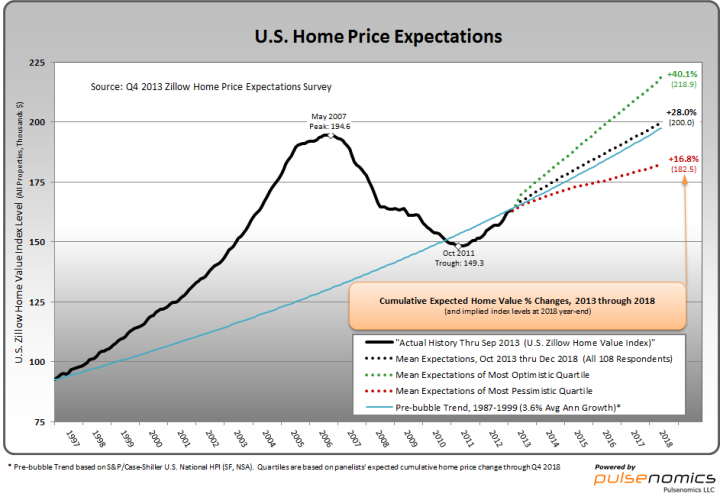
 While appreciation is expected to remain strong through the remainder of this year, the pace of home value growth is predicted to slow considerably through 2018. Panelists said they expect appreciation rates to slow to roughly 4.3 percent next year, on average, eventually falling to 3.4 percent by 2018.

Based on current expectations for home value appreciation over the next five years, panelists predicted that overall U.S. home values could exceed their May 2007 peak by the first quarter of 2018, and may cross the $200,000 threshold by the end of 2018.

“The housing market has seen a period of unsustainable, breakneck appreciation, and some cooling off is both welcome and expected,” said Zillow Chief Economist Dr. Stan Humphries. “Rising mortgage rates, diminished investor demand and slowly rising inventory will all contribute to the slowdown of appreciation.”

The most optimistic quartileii of panelists predicted an 8.3 percent annual increase in home values this year, on average, while the most pessimistic quartileiii predicted an average increase of 5.6 percent. Expectations among the optimists fell from 9.3 percent in the last survey, but rose from 5.1 percent among the pessimists. The most optimistic panelists predicted home values would rise roughly 12.5 percent above their 2007 peaks by the end of 2018, on average, while the most pessimistic said they expected home values to remain about 6.2 percent below 2007 peaks.

Diminished, But Still ‘Significant’ Role For Federal Gov’t in Mortgages

A number of public and private plans for overhauling the nation’s mortgage finance system and reforming government-sponsored entities Fannie Mae and Freddie Mac have been proposed, all of which seek to reduce and redefine the government’s role in the mortgage market to some degree. As these policy conversations begin, panelists were asked how involved they think the federal government should be in any re-imagined mortgage system. Among those panelists expressing an opinion, the majority (58.4 percent) said the federal government’s involvement in the conforming mortgage market should be “somewhat significant,” “significant” or “very significant.” Only 8 percent of respondents said the federal government should have a “non-existent” role in the conforming market.

Panelists were also asked to define an appropriate level of government-backing for mortgage loans going forward. Among those panelists expressing an opinion about what maximum percentage of all new mortgages should be backed by the federal government, the median response was 35 percent, roughly the level seen in 2006 at the height of the housing bubble.

“Policy discussions centered on reforming the nation’s housing finance system have only just begun, and it will be very interesting to see what comes out of these debates and how the market will react to new proposals,” Humphries said. “How much mortgages will end up costing average consumers, and the continued availability of traditional mortgage products like the 30-year fixed rate mortgage, are among the critical issues currently at stake for consumers in these debates.”

“Currently, the federal government backs roughly 90 percent of all new mortgage originations in the U.S. in some form,” said Pulsenomics® Founder Terry Loebs. “In 2000, prior to the bubble, the government backed about 50 percent of new mortgages. These benchmarks and survey data are another reminder of the challenges that lie ahead in reforming U.S. housing institutions.”

Filed Under: Roy's Blog Tagged With: Brea house for sale, Brea houses for sale, Brea real estate, Brea real estate for sale, buyer real estate news, housing data, housing market, north orange county for sale, north orange county real estate, orange county housing info, orange county real estate, Orange county real estate for sale, real estate information, real estate news orange county

Banks offering mortgages with only 5% down payments

November 8, 2013 By Roy Hernandez Leave a Comment

NEW YORK (CNNMoney)

Good news for homebuyers who don’t have a lot of cash on hand: Banks are offering loans with down payments of just 5%.

After the housing bubble burst, buyers needed to come to the table with as much as 20% down or they had to turn to the Federal Housing Administration for a low down-payment loan.

But now banks like TD Bank, Bank of America (BAC, Fortune 500), and Wells Fargo (WFC, Fortune 500) are loosening the purse strings, offering loans with down payments that are as low as 5%.

TD Bank’s “Right Step” mortgage, for example, allows borrowers to secure a loan with a 5% down payment. It also allows them to receive as much as 2% of the sale price as a gift from a relative or other third party, so they would really only need 3% down.

Why the change of heart? Market opportunity for one thing.

FHA dominated the market for low down payment loans during the housing bust. Taking on all those risky loans, however, depleted the agency’s reserves and has forced it to increase costs.

Related: Money 101 Tips for buying a home

Over the past couple of years, the FHA has been raising premiums. And this year, it started requiring borrowers to buy private mortgage insurance for the life of the loan — an expensive proposition that has sent many prospective borrowers looking elsewhere.

While the loans were far too risky for private lenders to take on before, rising home prices have made them less of a gamble. Plus, the banks think they can offer a better deal than FHA.

“As the FHA selectively reduced market share by increasing premiums, we introduced a substitute for FHA loans,” said Malcom Hollensteiner, the director of retail lending sales for TD Bank.

While the private lenders that are offering the 5%-down loans are also requiring borrowers to buy private mortgage insurance, they are only requiring them to do so until they build up 20% equity in the home.

Related: What will your monthly mortgage payment be?

The difference can really add up. Paying an insurance premium over the life of a $200,000, 30-year fixed-rate loan from FHA that carries an effective mortgage rate of 4.4% (5.75% when you tack on the insurance premium), can add up to nearly $60,000 over the life of the loan.

Of course, homeowners can always refinance to end their FHA insurance, but rates are so low that by the time an FHA borrower is able to refinance to a lower rate, it may not be worth it.

Filed Under: Roy's Blog Tagged With: Brea house for sale, Brea houses for sale, Brea real estate, Brea real estate for sale, buyer real estate news, housing news, north orange county for sale, north orange county real estate, Orange county real estate for sale, real estate information, real estate news orange county

4 Ways to Know Whether to Sell or Stay Put

October 24, 2013 By Roy Hernandez Leave a Comment

Sell or stayEvery real estate market creates its own buyer and seller personas, or profiles. When the market is slow and prices are low, it brings out ‘the wheeler-dealer’ and ‘the lowballer,’ as well as the ‘paralyzed panicker’ in some buyers.

But sellers aren’t immune.

And in a warm or hot market climate, the rise in home prices makes some sellers wonder whether they should exercise the freedom of finally having some home equity and make a move, or if it’s a better idea to stay put in hopes they can sell for more, next year or later.

Truth is, whether any given person should sell their home or stay put at any given time is a highly personal decision. Market dynamics should come into play, but that should be considered in the context of your personal life, career, family and financial plans.

Trying to figure out whether to sell or stay put? Here are four ways to know which decision is right for you.

1.  Sign You Should Sell: You frequently crave a neighborhood upgrade. I have known people who have liveed in “up and coming neighborhoods” for 20 years, and are still waiting for it to up-and-come. Others own homes on streets or in subdivisions they used to love that have changed dramatically because the city has been built up in a different direction, the area was rezoned, or because a school, freeway, commercial development, airport or train station was brought in. And still other home owners fall out of love with their neighborhoods because their job has moved, making their commute a pain.

In any event, if your home’s location is seriously misaligned with your life or your tastes, that fact is one you face all day, every day, for the duration of the time you live in the property. It can become a serious source of life dissatisfaction and resentment that rears its ugly head every time you make your monthly mortgage payment. As I see it, dissatisfaction with your neighborhood or a serious neighborhood-life disconnect can be a strong reason to sell and move, assuming you can make a move to a neighborhood that would better serve your life in a financially responsible way.

2.  Sign You Should Stay:  You can totally afford a new house – if you sell a kidney. A few years back, a friend of mine wrote a book called Life Would be Perfect if I Lived in That House (Vintage 2011). In it, she told how her mother was so addicted to the grass-is-greener promise of moving to a new home that she would actually take her family Open House hunting, even when they were visiting towns they had no interest in moving to! She went on to relate her inherited real estate addiction to the national trend of “moving on up,” so to speak, with financial recklessness – the trend that many believe led to the Great Recession.

There’s nothing wrong with being a real estate aficionado, but it’s important to watch to make sure grass-is-greener-at-that-house syndrome isn’t motivating you to make a financially unwise decision to sell and move.

If you are considering selling your home and moving up, do your own financial home work. Run your own budgets, income and expense reports and other financials to understand what level of increased financial obligation, if any, your household finances can afford to take. Consider whether you might want to set up some savings, investing or debt elimination targets before making a move. Work with your financial planner, tax professional and your real estate and mortgage pros to fully understand all the financial implications, short- and long-term, of selling and moving before you put the sign up in the yard.

3.  Sign You Should Sell: Space-wise, your family is too close for comfort. (And things will get worse before they get better.) I marvel at how much stuff the smallest infant seems to need.  I once went to a baby shower that generated so many strollers, packable playpens and sheer gear that it took 2 SUVs and a station wagon to cart it all home – for a kid that ultimately weighed in at 6 pounds and some-odd ounces.

If you have very young children and you’re already tripping over each other, chances are good that their space needs will grow as they do, even after all the baby gear is gone. School-aged kids and teenagers develop their own hobbies and need space for studies and sports – and on top of that, many parents of young children can realistically anticipate moving their own parents in at some point in time.

If you’re struggling to find a space for everything (and everyone), project your space needs out five years into the future. If you think you’ll need less space in five years (e.g., because your kids will likely move out in that time frame), it might not make sense to buy a bigger home now. But if it looks like you’ll need more space before you need less, that can be a sound rationale for making a financially rational move.

4.  Sign You Should Stay:  You could fix what ails your home with relatively modest remodeling projects.  If your home is bothersome primarily because things don’t function very well or its aesthetics are out of whack with your style, you might be tempted to sell and move.  Here’s a tip-off: your “dream home” is the Open House one block over that is nearly identical to your home in location, size, architecture, bedrooms and baths, but is impeccably decorated and updated. If you find yourself in this situation, you might very well be able to resolve your issues by investing less than you would spend on the transactional costs of selling and buying another home into some small-to-medium-scale remodeling projects on your current home.

On a budget, painting, landscaping, replacing exterior trims and interior hardware and updating your kitchen appliances will likely give you the biggest boost in home love for your buck. Similarly, you can get a major enjoyment boost out of your home for very little money by bringing a handyperson in to fix all those niggling little items that make a home seem worn out, including:

  • drawers that stick
  • handles you have to jiggle
  • drafts that need stopping up, and
  • scrapes and scuffs that make a place look rundown.

That said, when you consider what you would spend on commissions and closing costs to sell one home and buy a nearly-identical new one, you might be able to justify a larger updating/upgrading budget. If you have a little more dough to spend, consider a kitchen or bath remodel, having some custom organizers built in, or putting in the wood floors or deck you’ve always wished for. You might be surprised how fast home hate can turn to love when you start pampering your property.

Sellers: What factors influenced your decision to sell?

Filed Under: Roy's Blog Tagged With: Brea community info, Brea house for sale, Brea houses for sale, Brea real estate, Brea real estate for sale, housing data, housing market, housing news, north orange county for sale, north orange county real estate, orange county housing info, Orange county real estate for sale, real estate information, real estate news orange county, seller information

Top schools equal higher home prices

October 14, 2013 By Roy Hernandez Leave a Comment

Any good parent wants their child to attend the best school possible, but when it comes to finding a home in a top school district, how much more are buyers willing to pay? A recent study performed by Redfin suggests that many parents are willing to shell out even more than you might think. If you’re trying to sell a home and want to get the most for it, you might want to consider “selling” the school first.

pic
Schools have always played an important role in the buying and selling of real estate. More recently though, premiums for homes served by top-ranked schools have been going up, indicating that buyers place remarkable importance on the quality of schools when buying a house.

An analysis by Redfin illustrates the steep price premiums that homeowners are willing to pay for homes served by top-ranked schools, offering the latest concrete evidence that buyers place remarkable importance on the quality of schools.

The sky-high premiums help explain the ongoing race among listing sites to provide razor-sharp school information.

They could also add fuel to a debate over whether buyers and the real estate agents representing them give too much weight to rankings, which school officials say don’t always provide a complete picture of the differences in the quality of education provided.

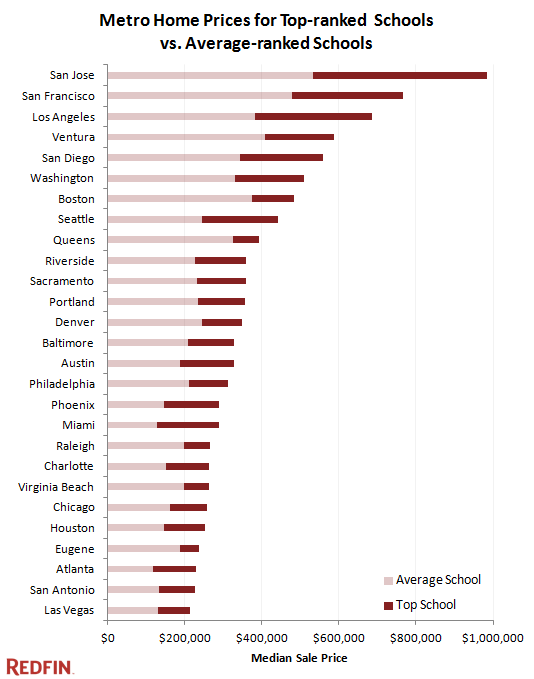
Redfin’s study found that buyers pay an average of $50 more per square foot for homes served by top-ranked schools than for those served by average-ranked schools. It also found found that, even within the same neighborhoods, buyers will pay substantially more for homes served by top-ranked schools than they do for comparable homes served by average-ranked schools.

“Homes just a short distance apart with nearly identical attributes are selling for drastically different prices,” the report said. “We’ve looked across the country at homes that have sold in the last three months and found five examples where the prices vary on identical homes by as much as $130,000.”

Not accounting for home size, San Jose, San Francisco and Los Angeles, Calif., carry the highest price premiums for top-ranked schools while Queens, N.Y., Raleigh, N.C., and Eugene, Ore., carry the lowest of all the metros that Redfin analyzed.

redfind-school-study

The report adds to a growing body of evidence that suggests that many homebuyers are ready to shell out substantial cash for access to top-notch schools.

Three out of 5 homebuyers who responded to a recent realtor.com survey said that school attendance boundaries would be a factor in choosing a home, and most of that group said they’d be willing to go above budget or give up amenities to have their children go to their school of choice.

The online survey, conducted this summer, found that of those who said school attendance boundaries were important:

  • 23.6 percent would pay 1 to 5 percent above budget.
  • 20.7 percent would pay 6 to 10 percent above budget.
  • 9 percent would pay 11 to 20 percent above budget.
  • 40.3 percent would not go above budget.

school kids      Some school officials have questioned whether buyers and their agents are relying too heavily on test scores and school ranking sites when pricing listings.

      The San Francisco Chronicle has reported that buyers in San Mateo County, Calif., are willing to pay premiums of $200,000 or more for homes served by schools that score only slightly better than other schools in the same school district. School district officials told the newspaper that homebuyers and their agents may read too much into simplified school rankings offered on real estate sites, and are working with Realtors in the hopes of helping them gain a better understanding of what qualities make for a good school.

     A Canadian real estate agent who’s branded herself as her community’s “#1 schools advisor” has rankled school district officials and parents by posting not only standardized test scores on her website, but devising her own system for ranking them. The ranking system penalizes schools with lower household income and parental education levels, or a higher prevalence of single-parent households and English-as-a-second-language (ESL) students.

The increasingly evident focus among buyers on school quality has helped spur a push by listing services to offer deeper school-centric features and data.

Zillow rolled out a school search boundary tool earlier this month that lets users filter home searches for public, private and charter school attendance boundaries by their ratings from a national school rating site.

A handful of other sites, including realtor.com, Trulia and Century 21 Real Estate, offer school-based search tools.

For its study, Redfin analyzed listings on multiple listing services that sold between May 1 and July 31; school zone boundaries provided by Maponics; and additional school data provided by Onboard Informatics and GreatSchools.

Filed Under: Roy's Blog Tagged With: Brea house for sale, Brea houses for sale, Brea real estate, Brea real estate for sale, buyer real estate news, housing data, housing market, housing news, north orange county for sale, north orange county real estate, orange county housing info, orange county real estate, Orange county real estate for sale, real estate information, real estate news orange county, seller information

Forecast: Calif. home prices to rise 6% in 2014

October 8, 2013 By Roy Hernandez Leave a Comment

California home prices and sales are projected to continue rising next year, but price gains will be much more modest than seen in the past year, according to the California Association of Realtors’ 2014 housing forecast.

The 2014 median house price house is projected to rise to $432,800 statewide, up 6 percent from this year’s projected all-year median of $408,600.

The median price of an existing single-family home was up 28.4 percent in the year ended in August and is projected to end the year up 28 percent from 2012 levels. But prices climbed dramatically this year due to a tight supply of homes for sale just as demand came roaring back and interest rates remained at historic lows.

The gains meant that more homeowners who owed more on their mortgages than their homes were worth were freed up to sell their homes.

“As the market continues to improve, more previously underwater homeowners will look toward selling, making housing inventory less scarce in 2014,” said association Chief Economist Leslie Appleton-Young. “As a result of these factors, we’ll see home price increases moderate from the double-digit increases we saw for much of this year to mid-single digits in most of the state.”

Realtor economists also project that home sales will rise 3.2 percent in 2014 to an annual total of 444,000 sales, the most sold in eight years. The 2013 sales tally is projected to fall about 2 percent short of 2012 levels.

Also on the increase: mortgage rates. The association predicted that interest on the traditional 30-year, fixed-rate mortgage will rise to 5.3 percent next year, up from an average of 4.1 percent in 2013.

For a median-priced home with a 20 percent down payment, that 1.2 percentage point gain amounts to a $236 increase in a monthly mortgage payment, or nearly $85,000 in increased interest over the life of the loan.

“The housing market has improved over the past year, and we expect this trend to continue into 2014,” said association President Don Faught. “As the economy enters the fourth year of a modest recovery, we expect to see a strong demand for homeownership, as buyers who may have been competing with investors and facing an extreme shortage of available housing return from the sidelines.”

Article courtesy of OC Register.

Filed Under: Roy's Blog Tagged With: Brea house for sale, Brea houses for sale, Brea real estate, Brea real estate for sale, housing data, housing news, north orange county for sale, north orange county real estate, orange county housing info, orange county real estate, Orange county real estate for sale, real estate information, real estate news orange county

8 Top Home-Selling Mistakes People Often Make

September 9, 2013 By Roy Hernandez Leave a Comment

   It’s a challenging market for home sellers right now. Buyers have a lot of options—and they don’t have to buy what you’re selling. Your house is likely just one located in a sea of for-sale signs, so you can’t be sloppy about putting it on the market.

Luckily, we’ve rounded up the dos and dont’s that will help you collect thousands (if not hundreds of thousands!) for your place.

Homer1. Don’t … ask for too much money.

Yes, you know what you paid for the house. But that doesn’t mean that it’s still worth that amount—or that it’s appreciated in value since you bought it. “Your house is only worth what the market is willing to pay you,” says certified financial planner Ellen Derrick of LearnVest Planning Services, who has bought and sold at least eight homes, including investment properties. “It doesn’t matter what’s in it. And it doesn’t matter what your mortgage is.” Your realtor has an eye on the market and knows what kind of prices homes—just like yours—are garnering now. Pricing your home too high will discourage interested parties from making an offer, and your property could sit for months, which isn’t your goal.

What to do: Have a few realtors give you a price on the home (or get a comparative market analysis), and—this is key—don’t ignore them. Keep in mind that even if you’ve made pricey improvements to the home (granite countertops, stainless steel appliances), you may not get your money back if you’re the only home on the block with such upgrades. If comparable kitchens in the neighborhood don’t have similar upgrades, buyers aren’t expecting fancy perks in yours, and may not be willing to pony up for the difference.

2. Don’t … skip the marketing.

You may think that all you have to do is take one photo of the house, stick a “For Sale” sign in your yard and buyers will come pouring in the door. Au contraire. “The only way to guarantee that you’re going to get the highest price for the house is to use all of the marketing options available to you,” says Holly Mellstrom, a realtor in Pelham, NY. “This means Internet advertising, 30 pictures of your house, public open houses and even postcards.” The more people who see your house, the better your chances are of selling it. In an age when buyers start their searches online, counting on drive-bys and word of mouth isn’t enough anymore.

What to do: Don’t wait until the last minute to notify a realtor that your house is for sale. If you can, give her at least a month of lead time, so she can research comparable homes and set a good price. “Give them time to book their favorite professional photographer,” Mellstrom says. “And give them time to photograph your house on a day the sun is out.” In fact, if you live in a seasonal area, and you know that you’re going to put the house on the market in February, have photos taken in September, when the grass is still green and the trees have leaves.

selling your home

3. Don’t … go it alone, unless you know what you’re doing.

If you’ve bought and sold half a dozen homes of your own or you live in a sought-after neighborhood where they sell in two days, you might be able to pull off a For Sale By Owner. If you aren’t a seasoned pro, however, let a professional take the reins. “Some people don’t buy and sell houses more than once or twice in a lifetime, and there’s a lot of money at stake,” Mellstrom says. “And there are so many disclosure laws now. Depending on the laws in your state, you’re really accepting some liability by trying to sell it yourself, unless you have a friend or an attorney who can guide you through the process.” A realtor also knows what’s selling around you, and for what price. She can tell you whether an offer is reasonable, and help you negotiate smartly. Plus, you may not save as much as you think in the end. “People who buy For Sale By Owner houses automatically discount the price they’re willing to offer because there is no realtor involved,” Mellstrom says.

What to do: If you can, get a realtor recommendation from a friend or colleague. Check references, conduct interviews and go with someone with a proven track record.

RELATED: So You’re Ready to Hire a Realtor

4. Don’t … neglect to fix things that are broken.

If sellers walk through your house and spot a handful of items that need immediate repair, they’re going to wonder how well you’ve maintained the things they can’t see. The entry way is a big tip-off. Got a loose hand rail on the steps, sagging screen door or jiggly door knob? Fix them. Clear your gutters, patch holes in your walls and address dripping faucets.

What to do: Do a walk-through of your own home, pretending that you’re seeing it for the first time. What things have you always meant to fix? Now is the time. Spend a few weekends dealing with all of those niggling projects to get your home in show-worthy shape.

5. Don’t … get emotionally involved.

Yes, it’s your house. Yes, you sweated blood and tears to get it just the way you wanted it. But, no, that does not make it someone else’s “perfect,” particularly when you’ve made some unique decorating decisions. You want the space to look as neutral as possible, so buyers can envision themselves in the space. So even if those teal walls in the bedroom look knock-out great with your duvet, they probably won’t match anyone else’s things. Let go of the features you love, and make it a house most people could love—and that might mean painting all of the walls a soft, neutral color. “My office at home is a robin’s egg blue,” Derrick says. “But if we get ready to sell that house, you can bet I’m repainting it.”

What to do: Have a realtor walk through your home, and when she tells you what you’ll need to change to make it marketable, listen to her. Start thinking about your house as a commodity, not an extension of your identity. If buyers don’t love it, it’s not a personal insult. It’s simply a deal that didn’t work out.

RELATED: 3 Unusual Tips to Help You Sell Your Home

6. Don’t … leave your stuff everywhere.

You want buyers to feel like they could move into your house tomorrow—with their things. And your collectible tchotchkes, photos and utility bills make the space feel a little too personal. “That first impression is really important, and if they’re greeted with a huge photograph of you on your wedding day 25 years ago over the fireplace, that’s really distracting,” Mellstrom says. “It sends the message to the buyer that ‘This is my house, not your house.’”

What to do: Before you put the home on the market, get a few boxes and grab every extraneous thing you see: photos, knick-knacks, books. If it helps, take a few pictures of each room, and try to view them through a buyer’s eyes. What could you remove from each room to make the space feel bigger? “You want it to look like a hotel room,” Derrick says. “Hotel rooms look comfortable, but they don’t look like they’re somebody else’s comfortable.” Also? Don’t hang out at showings. While you may want to tell prospective buyers about all of the things you’ve done to the house, it’s best to leave them be. If there’s some information you think is important for them to know, leave a flyer on the kitchen counter.

RELATED: Tackle 40 Household Tasks With Only These 5 Items

7. Don’t … get offended by a lowball offer.

Just because someone came in with a really low bid is no reason to walk off in a huff. Now’s your chance to negotiate. “Buyers are trying to buy your house for the lowest price possible,” Mellstrom says. “Don’t blow them off. They might love your house. You can’t blame them for trying.” In other words, it’s not personal, and it’s not a slam on your housekeeping. It’s a business transaction.

What to do: Come back with a counteroffer. Typically, most buyers will come back with a second offer, which is a better indication of what they’re really willing to pay.

8. Don’t … lose a sale over something stupid.

It’s possible to get 99% of the way through a home sale, only to stall out at the end over a minor detail. Don’t be that seller. “I’ve seen people throw away getting a $450,000 house sold over somebody wanting to take the mantle instead of leaving the mantle over the fireplace,” Derrick says.

What to do: Unless it’s an heirloom that’s been in your family for generations, remember that you can probably find another one—but you may not find another buyer at that price. To be safe, if there are things you’re feeling like you can’t live without, such as the curtains you found at a crazy flea market or the light fixture you discovered at an antiques store, replace them with something else before you show the house.

[gravityform id=”13″ name=”Have a question or comment?”]

Filed Under: Roy's Blog Tagged With: Brea houses for sale, Brea real estate, Brea real estate for sale, buyer real estate news, north orange county for sale, north orange county real estate, orange county housing info, orange county real estate, Orange county real estate for sale, real estate information, real estate news orange county, seller information

5 Things Consumers Should Expect From Housing Market In 2013

January 7, 2013 By Roy Hernandez Leave a Comment

   In 2012, the national housing market finally turned a corner. We’ve now experienced 13 straight months of home value appreciation. Sales were up significantly over 2011 as buyers returned to the market, boosting demand.

   So what will 2013 have in store? Here are five things consumers can expect to see in the housing market next year:

    Up, Up and Away

  • The national housing market hit bottom in October 2011, and home values have since risen 5.3 percent from that trough. The most recent Zillow Home Value Forecast calls for 2.5 percent appreciation nationwide from November 2012 to November 2013.
  • According to a recent Zillow survey of more than 100 economists and analysts, respondents predicted home values (based on the S&P/Case-Shiller U.S. National Home Price Index) to rise 3.1 percent in 2013, on average.
  • Most markets covered by Zillow’s Real Estate Market Reports have already bottomed out, with only 10 of 255 covered metro areas not projected to hit a bottom within the next year.

   Bottom Line: Homeowners looking to sell in 2013 can largely rest assured they won’t be selling at the bottom, and many will find themselves in a sellers’ market. Potential buyers in 2013 may be more motivated to get a deal done while affordability is still extremely high and mortgage rates continue to be historically low.

   Real Estate Is Local Again

  • According to the Zillow Breakeven Horizon, buying beats renting when staying in the home for three years or more in roughly 60 percent of U.S. metros. The areas where it might make more sense to buy (if you’re planning on staying for three-plus years) are clustered in the Southwest and Southeast. If you won’t be staying put for at least a few years, consider renting in the Northeast, where buying often doesn’t make more financial sense until five years or more.
  • The goal of Zillow’s Buyer/Seller Index is to determine where buyers have the most leverage in a sale, and where sellers might have the upper hand. In general, we determined that metro areas in the West and Southwest – including the Bay Area, Las Vegas and Phoenix – are strong for sellers. Metros in the Midwest and Mid-Atlantic – places such as Chicago, Cleveland and Philadelphia – are best for buyers.

   Bottom Line: The housing market recovery has remained true to the old real estate axiom of “location, location, location.” How your local market is faring today – and if it makes more sense to buy or rent, to sell now or to hold off if possible – is largely determined by unique, local factors and fundamentals. Arming yourself with timely and comprehensive local market information is good advice at any time, but will be even more important in 2013 as buyers continue to seek bargains and sellers look to maximize returns.

   Coming Up for Air

  • In the third quarter of 2012, the percentage of homeowners with a mortgage in negative equity – or “underwater,” owing more on their mortgage than their home was worth – fell below 30 percent for the first time since Zillow began tracking that data using an improved methodology in early 2011.
  • Still, 28.2 percent of homeowners with a mortgage remain underwater. Because underwater owners have a far more difficult time selling their home, a large number of homes that otherwise might end up on the market aren’t getting listed. As a result, inventory in many areas is incredibly tight, leaving buyers to fight it out amongst themselves, which in turn can help drive up prices. This, among other factors, has led to tight inventory in many of the hardest-hit cities around the country.

   Bottom Line: As home values continue their upward march in 2013, more homeowners currently trapped underwater will begin to surface. This will be good for buyers exhausted by limited inventory and intense competition in markets such as Phoenix and Miami, but it will also have the effect of cooling price increases. As a result, in 2013, we predict home value appreciation in many areas will look more like a series of steps, characterized by cycles of price spikes and plateaus. Price spikes will free some homeowners from negative equity, allowing them to sell, thereby easing supply constraints and dampening prices until the cycle is repeated.

   Historically Affordable

  • Mortgage interest rates have been hovering at or near historic lows for the past year, and the Federal Reserve has taken concrete steps to ensure they stay low for at least the foreseeable future.
  • At the same time, home values – while recovering nicely – still have a long way to go to reach their pre-bubble levels. Overall, national home values in November were still down 19.4 percent from their peak in May 2007, according to Zillow.

   Bottom Line: Between 1985 and 2000, Americans spent, on average, about 20 percent of their household income on mortgage payments. That percentage increased to more than 24 percent by 2006, before falling to just 13 percent by the second quarter of 2012. If you can qualify for a home loan, the combination of low rates and low prices means your home-buying dollar will continue to take you farther in 2013 than in recent years, even for buyers on modest budgets.
Mortgage Interest Deducted?

  • Changes to the mortgage interest deduction (MID) may be a key element of any “grand bargain” reached by politicians in order to avert the year-end fiscal cliff. If adopted, any measure to limit or repeal the MID will result in some home price impacts over time and by market segment.
  • Home values at the high end of the market will likely be more negatively impacted by MID changes than home values overall, according to a recent Zillow survey of economists. For example, in the event that the maximum MID-eligible mortgage amount is reduced from $1 million to $500,000 and the deduction allowance for second homes is eliminated, the majority of respondents said they expect high-end home prices to fall while U.S. home prices overall experience little or no price impact.

   Bottom Line: Real estate lobbying groups have long fought against changes to tax rules allowing for the deduction of mortgage interest, arguing that any changes will impact or eliminate some of the historic financial advantages of owning a home. But unless you’re buying a proportionally more expensive home or are buying in a more expensive area, the impacts of MID changes will likely be muted. The decision to buy or sell a home is highly personal and dependent on a number of factors, only one of which is potential tax implications. In 2013, make your decision to buy or sell based on your own informed opinion and your unique situation.

   Click here to contact Roy for more information or questions concerning your real estate goals.

Filed Under: Roy's Blog Tagged With: Brea bank owned for sale, Brea community info, Brea house for sale, Brea houses for sale, Brea real estate, Brea real estate for sale, Brea REOs for sale, foreclosure for sale, north orange county for sale, north orange county real estate, orange county housing info, Orange county real estate for sale, orange county shadow inventory, real estate information, real estate news orange county

  • « Previous Page
  • 1
  • 2
  • 3

RoyaltyAgent@gmail.com

Search All Houses FOR SALE

Hot Bank Foreclosures & REO

Current Mortgage Rates

[mlrates state="CA" size="narrow"]

Fullerton Homes FOR SALE by Price

$300,000- $500,000
$500,000- $700,000
$700,000- $900,000
$900,000- $1,100,000
$1,100,000 and above

Fullerton Condos FOR SALE by Price

$200,000- $300,000
$300,00- $400,000
$400,000 and above

Our Coverage Areas

Brea Homes FOR SALE

Brea North Hills FOR SALE

Whittier Homes FOR SALE

Fullerton Homes FOR SALE

Placentia Homes FOR SALE

La Habra Homes FOR SALE

Yorba Linda Homes FOR SALE

Anaheim Homes FOR SALE

Brea Special Events

Community Reports

downtown brea

City Information


Brea

Yorba Linda

Placentia

Fullerton

La Habra

Tag Cloud

Anaheim Hills real estate for sale Anaheim house for sale bank owned Brea bank owned for sale Brea community info Brea foreclosure for sale Brea house for sale Brea houses for sale Brea real estate Brea real estate for sale Brea REO Brea REO for sale buyer real estate news foreclosure for sale Fullerton house FOR SALE Fullerton houses for sale Fullerton real estate Fullerton Real Estate For Sale fullerton resort living housing data housing market housing news la habra houses for sale La Habra real estate for sale north orange county for sale north orange county real estate orange county housing info orange county real estate Orange county real estate for sale orange county shadow inventory placentia condos for sale placentia for sale placentia homes for sale placentia houses for sale placentia real estate real estate information real estate news orange county REO for sale REO property for sale seller information whittier houses for sale Yorba Linda for sale Yorba Linda homes for sale yorba linda houses for sale Yorba Linda real estate for sale
The Virtual Realty Group
Roy Hernandez
cell/text (949) 922-3947
RoyaltyAgent @ gmail.com
RoyalAgent.net
BRE#01202958
  • Blog Page
  • I’d like to sell my house
  • About

Copyright © 2026 Website by The Burrell Group · Log in