• Home
  • Buyers
    • Buyer’s Guide
    • For Buyers
    • Buyer Wish List
  • Sellers
    • Seller’s Guide
    • For Sellers
    • Property Updates
    • Marketing & Listing Proposal 2019
    • Prepare your house For Sale
    • How much is my house worth today?
  • City Info
    • Search All Towns USA
    • Community Reports
    • Anaheim
    • Brea
    • Orange
    • Fullerton
    • La Habra
    • Placentia
    • Santa Ana
    • Yorba Linda
  • News
  • Schools
  • Contact Us

Roy Hernandez Real Estate Services

Orange county real estate houses for sale

You are here: Home / Blog Page

OC Housing Report: Slim Pickens

June 30, 2017 By Roy Hernandez Leave a Comment

Story and graphics compliments of Steven Thomas, QEDS

Hello!

For years now the Orange County housing inventory has been
low, but this year it is more pronounced.

Low Supply: The active listing inventory has been down all year and it is currently off by 14% compared to 2016. 

Whew! It is tough to be a buyer looking for a home in today’s market. The biggest complaint has to be that there are simply not enough choices. In fact, nearly 1,200 fewer homes have come on the market so far this year compared to last year. The active inventory currently sits at 5,905 homes; that is 14% fewer than the 6,868 that were available last year.

The trend of fewer homes hitting the market dates back to the beginning of the Great Recession, 2008. Ever since then, fewer and fewer homeowners have placed a FOR SALE sign in their yard. This trend is nothing close to a blip on the radar screen. Something happened to everybody’s collective psyche during the drawn out and bruising recession. Homeowners are staying put.

This year has been off from last year, averaging 222 fewer homes placed on the market each month. As the half way point for the 2017 housing market rapidly approaches, the slower pace has added up. Buyers who have been working hard to secure a home without any luck can attest to the need for additional choices. Yet, the 222 year over year difference is nothing compared to the number of homes on the market during the first decade of the 2000’s. In 2006, there were 2,239 additional homes FOR SALE coming on each and every month. That added up to an additional FOR SALE sign in just about every neighborhood on a monthly basis.

Story and graphics compliments of Steven Thomas, QEDS


Price is determined by supply and demand. Just for kicks, imagine that demand remained the same. When the same number of buyers are interested in purchasing a home, yet the supply drops considerably, the highest bidder wins. As a result, prices rise. Essentially, that is what has happened over the past five years. In 2012, demand spiked; however, there were not enough homes on the market to satiate the voracious appetite for buyers to buy. Home values have been on the rise ever since.

In past housing run-ups, homeowners have been encouraged and enticed to join the fray, eager to cash in on the market and make a move. That has not been the case during the current five year run. Homeowners have not been tempted to sell like they did from 2000 through 2007.

ADVICE FOR BUYERS: be realistic out of the gate. Don’t delay in pulling the trigger to write an offer to purchase a home. You do not have to overpay, especially now that the housing has transitioned into the Summer Market. Offer the FAIR MARKET VALUE for a home. Most of all, pack your patience.

ADVICE FOR SELLERS: be realistic out of the gate. Far too many seller hit the market overpriced. The market has been on the rise, but it does a majority of its annual appreciation during the Spring Market. Homes appreciate at a much slower rate for the rest of the year. Orange County detached housing values have been increasing at a pace of about 5% per YEAR. That is 365 days, not 30 days. So, price accordingly. A wise strategy is to price a home at its FAIR MARKET VALUE. The better the price, the more activity that is generated. Multiple offers drive the sales price up.

Active Inventory: The active inventory increased by 3% in the past couple of weeks.
The active listing inventory added an additional 148 homes in the past two-weeks, a 3% increase, and now sits at 5,905. Within the next couple of weeks, the inventory will eclipse the 6,000 home mark. Last year that occurred at the start of May.

We can expect the inventory to continue to rise throughout the Summer Market until it reaches a peak somewhere around mid-August. From there, the market will transition into the Autumn Market, from mid-August through Thanksgiving, with fewer homes coming on the market with both the spring and summer in the rearview mirror.

Last year at this time, there were 6,868 homes on the market, 16% more than today.

Story and graphics compliments of Steven Thomas, QEDS


Demand: Demand increased by 1% in the past couple of weeks.
Demand, the number of homes placed into escrow within the prior month, increased by 33 pending sales in the past two-weeks and now totals 2,937, a 1% increase. Demand is off the most in the entry-level market, homes priced below $500,000. With 23% fewer homes that have been placed on the market so far this year below $500,000, demand is now off by 21%. This market has been underperforming all year due to a real lack of inventory.

We can expect demand to drop slightly from now through the end of the Summer Market.

Last year at this time, there were 52 more pending sales totaling 3,989, or 2% more. The expected market time increased from 59 to 60 days in the past couple of weeks. At 60 days, the market is no longer a HOT seller’s market, but a tepid seller’s market with muted appreciation. Last year it was at 69 days.

Luxury End: Luxury demand increased by 6% in the past couple of weeks while the inventory grew by 2%.
In the past two weeks, demand for homes above $1.25 million increased from 351 to 371 pending sales, a 6% increase and nearly the same level as a month ago. The luxury home inventory increased from 1,981 homes to 2,011, up 2%. Even with the increase in demand, the luxury market is NOT a robust seller’s market, taking months in order to find success.

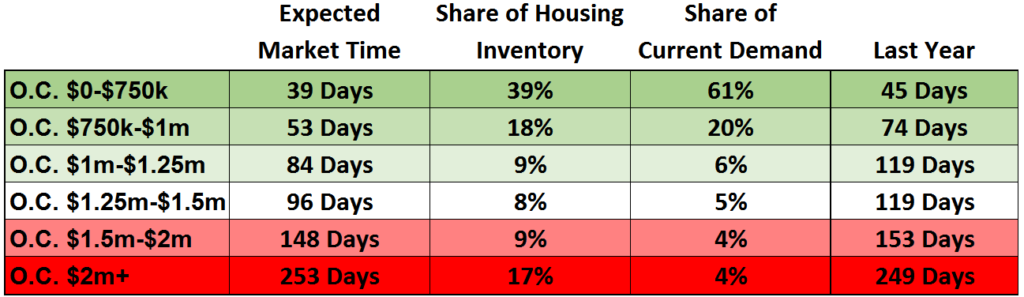
For homes priced between $1.25 million and $1.5 million, the expected market time decreased from 108 to 96 days. For homes priced between $1.5 million to $2 million, the expected market time increased from 144 to 148 days. In addition, for homes priced above $2 million, the expected market time decreased slightly from 256 days to 253 days. At 253 days, a seller would be looking at placing their home into escrow around the end of February of next year.
Story and graphics compliments of Steven Thomas, QEDS

Orange County Housing Market Summary:

• The active listing inventory increased by 148 homes, or 3%, in the past couple of weeks, and now totals 5,905, knocking on the door of the 6,000 home level. Last year, there were 6,868 homes on the market, 963 more than today.

• There are 35% fewer homes on the market below $500,000 today compared to last year at this time and demand is down by 21%. Fewer and fewer homes and condominiums are now priced below $500,000. This price range is slowly disappearing.

• Demand, the number of pending sales over the prior month, increased by 1% in the past couple of weeks, adding 33 pending sales and now totals 2,937. The average pending price is $845,004.

• The average list price for all of Orange County remained at $1.6 million. This number is high due to the mix of homes in the luxury ranges that sit on the market and do not move as quickly as the lower end.

• For homes priced below $750,000, the market is HOT with an expected market time of just 39 days. This range represents 39% of the active inventory and 61% of demand.

• For homes priced between $750,000 and $1 million, the expected market time is 53 days, a hot seller’s market (less than 60 days). This range represents 18% of the active inventory and 20% of demand.

• For homes priced between $1 million to $1.25 million, the expected market time is at 84 days, a tepid seller’s market.

• For luxury homes priced between $1.25 million and $1.5 million, the expected market time decreased from 108 to 96 days. For homes priced between $1.5 million to $2 million, the expected market time increased from 144 to 148 days. For luxury homes priced above $2 million, the expected market time decreased from 256 to 253 days.

• The luxury end, all homes above $1.25 million, accounts for 34% of the inventory and only 13% of demand.

• The expected market time for all homes in Orange County increased from 59 days to 60 in the past couple of weeks, changing from a hot seller’s market to a tepid seller’s market (60 to 90 days). From here, we can expect the market time to slowly rise throughout the Summer Market.

• Distressed homes, both short sales and foreclosures combined, make up only 1.2% of all listings and 2.1% of demand. There are only 25 foreclosures and 46 short sales available to purchase today in all of Orange County, that’s 71 total distressed homes on the active market, 5 fewer than two weeks ago. Last year there were 138 total distressed sales, 94% more than today.

• There were 3,147 closed sales in May, an 18% increase over April 2017 and a 4% increase over May 2016. The sales to list price ratio was 97.8% for all of Orange County. Foreclosures accounted for just 1.1% of all closed sales and short sales accounted for 1.7%. That means that nearly 97.2% of all sales were good ol’ fashioned equity sellers.

Have a safe Holiday!

Sincerely,
Roy A. Hernandez
TNG Real Estate Consulants
Cell 949.922.3947

[gravityform id=”22″ title=”true” description=”true”]

Filed Under: Roy's Blog

OC Housing Report: Applying the Brakes

May 23, 2017 By Roy Hernandez Leave a Comment

Hello!

As housing transitions into the Summer Market, there are more
For Sale signs while demand softens.

The Summer Shift: The annual tradition is no different in 2017, housing is shifting from the Spring Market to the Summer Market. It is the season for commencement speeches, diplomas, and caps thrown into the air to mark the end of a chapter and the beginning of something new. Similarly, this is the season where the robust, hot Spring Market comes to an end, making way for a different market, a new chapter in local real estate, the Summer Market.

While the Summer Market may be the second busiest time of the year for real estate, sellers, buyers, and real estate professionals feel a palpable shift. The active listing inventory slowly and methodically grows from now through mid-August. At the same time, demand softens slightly from the peak of 2017, which occurred two weeks ago.

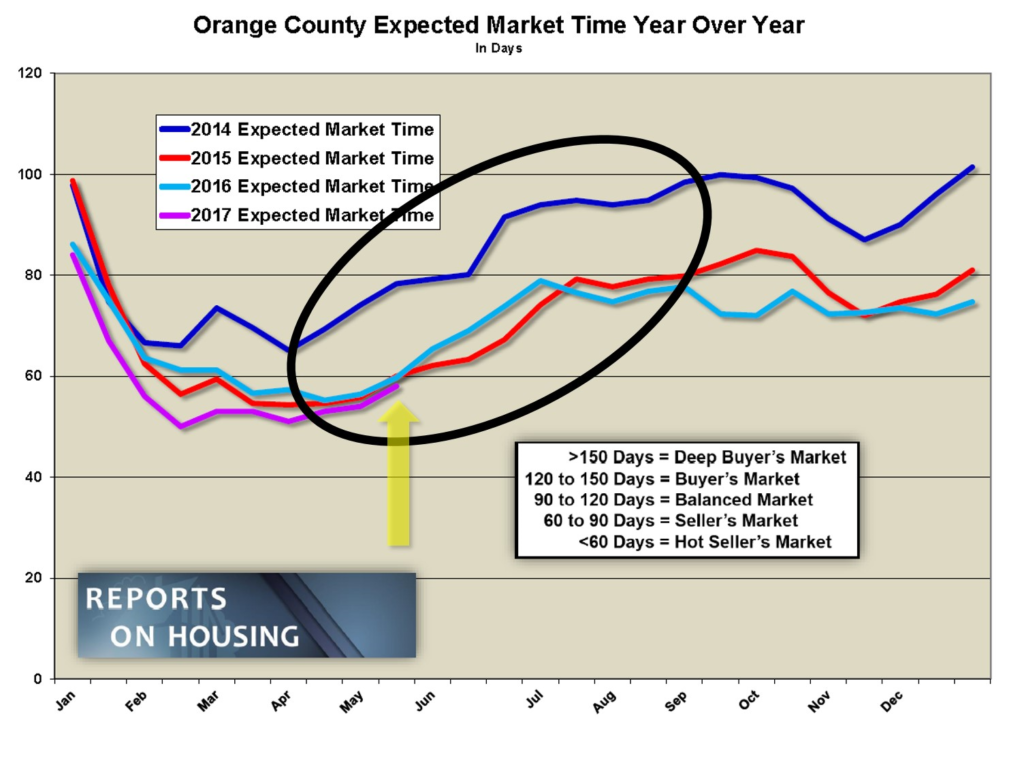
Many mistakenly think that right now is the absolute best time to come on the market. It is just not true. The best conditions actually occurred at the start of April when the expected market time hit a low. Since then, the expected market time has been slowly rising and will continue to rise from now through the 2017 peak in the active inventory, which typically occurs around mid-August.

Photo/Article courtesy of Steven Thomas.

This shift occurs because summer is full of distractions. From the beach, to the pool, to vacations, buyers’ attention is diverted a bit. Not to mention, the number one distraction, everybody’s kids are on summer break too. It’s just not as easy to see homes when the kids are not confined to their school classrooms.

Even though it will continue to be a seller’s market, overall housing is just about to move from a hot seller’s market to just a seller’s market. The stark difference in this market can be isolated to a bit less activity with not as many offers generated. This shift is much more dramatic in the higher price ranges, from $750,000 and up.

It may be a seller’s market, but sellers really need to approach pricing with extreme caution and care. For sellers who aggressively stretch their asking prices, they risk not being successful and missing both the Spring and Summer Markets. Arbitrarily picking a desired sales price and ignoring the closed and pending sales data is a recipe for disaster and a waste of valuable market time.

For example, a home that sold in December 2016 at $800,000 is not worth $900,000 today, over 12% higher. The market has been appreciating at about 5% annually. That means it takes 365 days for a home to appreciate 5%, not 3 months, not 6 months, not 9 months. It takes a year. On average in Orange County, that $800,000 home would be worth about $820,000, 6-months later. That is 2.5% more.

Additionally, it is worth mentioning that this simple example does not work for every property in every neighborhood. The appreciation rate varies from area to area, neighborhood to neighborhood, and sometimes from street to street. A professional REALTOR® can help dissect the recent closed and pending sales data to help establish the best price for success. Sellers absolutely should NOT utilize Zillow to price a home. Zillow admits it themselves, stating, “The Zestimate® is a starting point in determining a homes’ value and is not an official appraisal.” It is just an approximation and leads to inaccurate pricing. Nothing beats carefully looking at the comparable sales data and comparing the property size, bedrooms, bathrooms, location, amenities, upgrades, condition, lot size, and every other nuance that goes into the sale of a home.

The bottom line is this: the market is slowly cooling right now and the window of opportunity to find success prior to the kids going back to school at the end of August is beginning to close. Sellers find success through accurate pricing. Price out of bounds and risk losing valuable market time during the best time of the year to sell, the Spring and Summer Markets.

Active Inventory: The active inventory increased by 4% in the past couple of weeks.
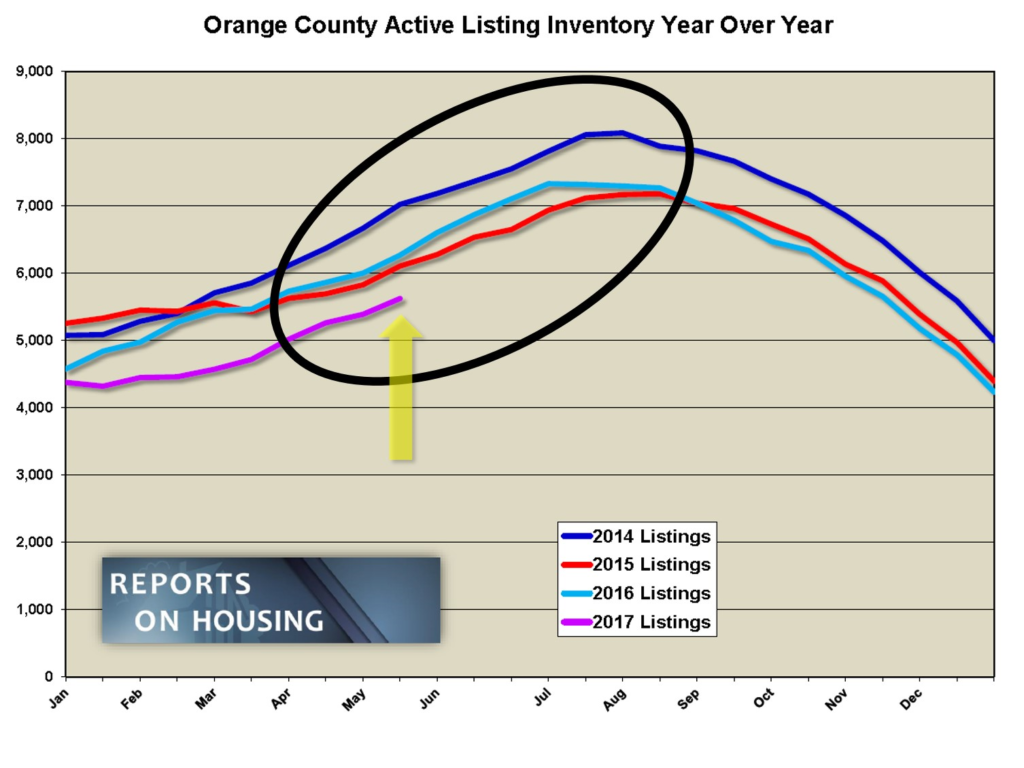
The active listing inventory added an additional 236 homes in the past two-weeks, a 4% increase, and now sits at 5,623. Expect the inventory to continue to rise until it peaks around mid-August. Even though demand peaks in April to early-May, more homeowners come on the market in the month of June than any other time of the year. Since demand is not as strong, the active inventory grows. As more homes accumulate on the market, there is more seller competition.

Last year at this time, there were 6,267 homes on the market, 11% more than today.

Photo/Article courtesy of Steven Thomas.

Demand: Demand dropped by 3% in the past couple of weeks.Demand, the number of homes placed into escrow within the prior month, dropped by 98 pending sales in the past month, or 3%, and now totals 2,914. In both 2015 and 2016, demand eclipsed the 3,000 mark for two months, compared to just two-weeks this year. A major contributing factor to this year’s phenomenon is the lack of homes coming on the market in the lower ranges. In the last 30 days, there have been 21% fewer homes placed on the market below $500,000, and 11% fewer from $500,000 to $750,000.

We can expect demand to drop slightly from now through the upcoming summer months.

Last year at this time, there were 230 more pending sales totaling 3,144. Current demand is off by 7% compared to last year. The expected market time increased from 53 to 58 days in the past couple of weeks. Last year it was at 60 days, very similar to today.

Luxury End: Luxury demand dropped by 7% in the past couple of weeks while the inventory grew by 4%.
In the past two weeks, demand for homes above $1.25 million decreased from 398 to 369 pending sales, a 4% drop. The luxury home inventory increased from 1,887 homes to 1,965, up 4%. Similar to the rest of the market, demand is dropping for luxury homes while the luxury inventory continues to grow. There is already plenty of seller competition in the upper ranges.

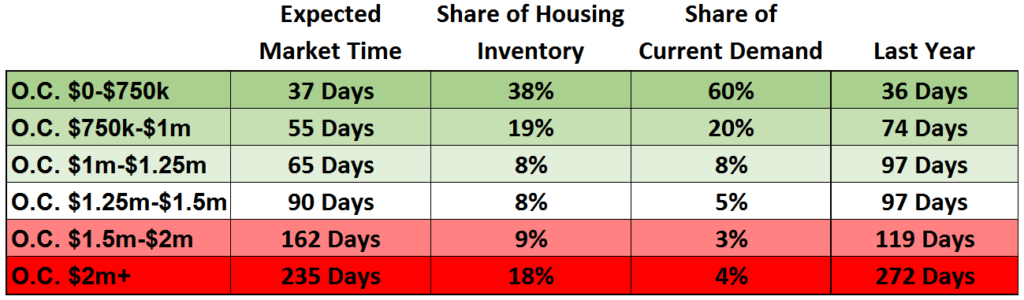
For homes priced between $1.25 million and $1.5 million, the expected market time increased from 89 to 90 days. For homes priced between $1.5 million to $2 million, the expected market time increased from 134 to 162 days. In addition, for homes priced above $2 million, the expected market time increased from 198 days to 235 days. At 235 days, a seller would be looking at placing their home into escrow around mid-January of next year.

Photo/Article courtesy of Steven Thomas.


Orange County Housing Market Summary:

  1.  The active listing inventory increased by 236 homes, or 4%, in the past couple of weeks, and now totals 5,623. Last year, there were 6,267 homes on the market, 644 more than today.There are 35% fewer homes on the market below $500,000 today compared to last year at this time and demand is down by 26%. Fewer and fewer homes and condominiums are now priced below $500,000. This price range is slowly disappearing.
  2.  Demand, the number of pending sales over the prior month, dropped by 3% in the past couple of weeks, shedding 98 pending sales and now totals 2,914 , dropping below 3,000 a bit earlier than the past couple of years. The average pending price is $859,899.
  3. The average list price for all of Orange County remained at $1.6 million. This number is high due to the mix of homes in the luxury ranges that sit on the market and do not move as quickly as the lower end.
  4. For homes priced below $750,000, the market is HOT with an expected market time of just 37 days. This range represents 38% of the active inventory and 60% of demand.
  5. For homes priced between $750,000 and $1 million, the expected market time is 55 days, a hot seller’s market (less than 60 days). This range represents 19% of the active inventory and 20% of demand.
  6. For homes priced between $1 million to $1.25 million, the expected market time is at 65 days, a seller’s market.
  7. For luxury homes priced between $1.25 million and $1.5 million, the expected market time increased from 89 to 90 days. For homes priced between $1.5 million to $2 million, the expected market time increased from 134 to 162 days. For luxury homes priced above $2 million, the expected market time increased from 198 to 235 days.
  8. The luxury end, all homes above $1.25 million, accounts for 35% of the inventory and only 12% of demand.
  9.  The expected market time for all homes in Orange County increased from 54 days to 58 in the past couple of weeks, a solid seller’s market (less than 60 days), but about to transition into a normal seller’s market (60 to 90 days). From here, we can expect the market time to slowly rise throughout the Spring and Summer Markets, moving from a deep seller’s market to a slight seller’s market.
  10. Distressed homes, both short sales and foreclosures combined, make up only 1.2% of all listings and 2.5% of demand. There are only 31 foreclosures and 37 short sales available to purchase today in all of Orange County, that’s 68 total distressed homes on the active market, 13 fewer than two weeks ago. Last year there were 141 total distressed sales, 107% more; that’s more than double.
  11. There were 2,663 closed sales in April, a 5% decrease over March 2017 and a 3% decreased over April 2016. The sales to list price ratio was 98.6% for all of Orange County. Foreclosures accounted for just 0.8% of all closed sales and short sales accounted for 1.4%. That means that nearly 98% of all sales were good ol’ fashioned equity sellers

Have a great week.

Roy A, Hernandez
TNG Real Estate Consultants
949.922.3947
RoyaltyAgent@Gmail.com

Photos and article courtesy of Steven Thomas.

[gravityform id=”22″ title=”true” description=”true”]
Filed Under: Roy's Blog

The Top Dates for Listing a Home Revealed

February 20, 2017 By Roy Hernandez Leave a Comment

Home listings are most likely to debut on Thursdays and Fridays, with Fridays being the most common listing day by a slight margin, according to research by the National Association of REALTORS®.

What are the most popular dates to list? Half of all new listings in 2016 were first listed between March and July, which supports that the spring season is indeed real estate’s busiest time.

The most popular month for new listings is April, followed by March, May, June, and July, according to NAR.

“While home closings exhibit a strong tendency to get done at the end of the month, listings are much steadier throughout the course of the month with a slight tendency to be posted earlier rather than later,” NAR researchers note at the Economists’ Outlook blog.

[gravityform id=”22″ title=”true” description=”true”]
Filed Under: Roy's Blog

4 Concrete Reasons to Remodel Your Home in 2017

February 4, 2017 By Roy Hernandez Leave a Comment


You know how you’ve always wanted to expand your family room to make it more open? Or how you’ve been dying to add an extra bathroom that you can have all to yourself? Well, our magic eight ball says the outlook is good for your home upgrade dreams: 2017 is a great time to finally take the plunge and renovate or remodel.

Why? Well, according to home improvement experts, your renovation will cost less today than if you were to wait until next year—for a variety of reasons.

“Concrete doesn’t double in a month, but costs do continually tick up,” says Dan Bawden, chairman of the National Association of Home Builders Remodelers and owner and CEO of Legal Eagle Contractors in Houston.

Bawden says renovating will never get cheaper than it is now.

If you’re a glass-half-empty kind of person, that news might bum you out. But we take it to mean 2017 is the most cost-efficient time to renovate. Do it soon—here’s why.

(For a chance to win $20,000 to spend on the home of your dreams, enter the realtor.com® Entryway to $20K sweepstakes at realtor.com/entryway20k. No purchase necessary. See official rules.)

Reason No. 1: Consumer confidence is improving

As job growth increases and wages improve, people generally feel good about the economy and their future. That makes them also feel good about investing in home improvements.

“Remodeling decisions are made by families based upon their consumer confidence,” Bawden says.

And that confidence, for now, is increasing. In December 2016, the Consumer Confidence Index posted another gain and reached 113.7—a virtually giddy number compared to when the index tanked to its all-time low of 37.7 in January 2009, the height of the Great Recession.

Bawden calls today’s confidence levels a “rising tide of optimism.”

“Last year we had a record year in my company, and I think 2017 is going to be a great year,” he says.

Reason No. 2: Contractor and construction worker availability is decreasing

Now we know 2017 is shaping up to be a busier year for contractors. That’s good news for the economy! But the bad news is this: The busier those contractors get, the longer you might have to wait to begin a remodeling project. Bawden says he already has a six-week wait period to begin new jobs, which is partly due to a dearth of skilled tradesmen available for hire.

And there’s a double whammy: There’s also a national shortage of construction workers—and these workers are not getting any younger.

“The average guy working for me is 55,” Bawden says. “It’s hard to find new people who are good.”

So if you’re hoping to squeeze in a home remodel or renovation, it’s better to do it now, before you’re relegated to the back of a very long line.

Reason No. 3: Financing is still affordable

Although some people might be sitting on piles of cash they can use for a remodel (we’re not jealous or anything), many rely on financing—often by borrowing against the equity in their homes. And these days, it’s a great time to take out a home equity loan or line of credit because home prices are rising and loan rates are still low.

But loan rates are certainly on the rise. At the end of November the interest on home equity loans stood at 4.82%. By the end of December, the rate was 4.97%. And in mid-January of this year, we’re looking at an interest rate of 5.21%.

Still, keep this mind: Even though borrowing costs are rising, so are home values. Lower inventory and mounting demand have bolstered home prices. The median existing-home price in November 2016 was $234,900, up 6.8% from November 2015, according to NAR research.

As the value of your home increases, so does your equity. And it’s primarily the equity in your home—the difference between the fair market value of your home and what you owe—that supports a loan you can use to add that bathroom or replace the roof.

“Having more equity opens up more opportunity,” says Jonathan Smoke, chief economist of realtor.com®. “Since interest rates are low and equity is up, now would be a great time to look into applying for a home equity loan.”

Reason No. 4: Material costs will increase

No matter how low U.S. inflation might be, prices for building materials manufactured around the globe always seem to go up. Even though inflation may be low here, it could be rising in Italy, where the bathroom tile you love is manufactured. Or tariff pressures might make that slab of granite from Brazil more expensive.

The result is that building costs, labor, and insurance, always rise—perhaps not quickly, but inevitably. And wouldn’t you rather remodel when it’s cheaper?

“If you (renovate) a house two years from now, it will be more expensive,” Bawden says. “Prices are always going up.”

[gravityform id=”22″ title=”true” description=”true”]
Filed Under: Roy's Blog

HUD suspends FHA mortgage insurance rate cut

January 21, 2017 By Roy Hernandez Leave a Comment

An hour after Donald Trump assumed the presidency Friday, his administration indefinitely suspended a pending rate cut for mortgage insurance required for FHA-backed loans, which are popular with first-time home buyers and those with poor credit.

The move by the Department of Housing and Urban Development — one of the first acts of Trump’s administration — reversed a policy announced in the waning days of the Obama presidency that would have trimmed insurance premiums for typical borrowers by hundreds of dollars a year.

Some Republicans expressed concern that the rate cut could cost taxpayers if the loans started to go sour and the Federal Housing Administration was unable to cover the losses. The agency needed a $1.7-billion bailout from the U.S. Treasury in 2013 after it expanded its role last decade after the collapse of the subprime mortgage market.

The FHA does not issue loans, but instead insures mortgages and collects fees from borrowers to reimburse lenders in case of default. Borrowers can qualify for an FHA-backed mortgage, with down payments as small as 3.5%, even with a credit score as low as 580, which could signal a past bankruptcy or debts sent to collection.

The average credit score of an FHA borrower in the third quarter of last year was 679, a credit worthiness considered to be fair.

FHA-backed loans have seen robust growth in recent years and lenders not chartered as banks now control a majority of the riskier FHA market. The shift toward nonbank lenders also has drawn concerns because banks have strict reserve requirements while the crop of new lenders operates under a variety of business models.

Last week, during a confirmation hearing for Trump’s nominee for HUD secretary, Ben Carson, Sen. Pat Toomey (R-Pa.) argued that private mortgage insurance should play a larger role in the market for homes acquired by buyers who can’t afford traditional 20% down payments.

Carson appeared open to such a possibility and told Toomey it didn’t matter what entity provided insurance, but “we do have to have a mechanism, backstop.”

Carson also said he was surprised by the recent FHA rate cut and promised that if confirmed he would work with the “FHA administrator and other financial experts to really examine that policy.”

The suspension of the rate cut, set to take effect Jan. 27, came before his confirmation vote.

In a letter announcing the suspension Friday morning, HUD, which oversees the FHA, said more analysis is needed on any “future adjustments” to insurance premium rates. For most borrowers, the rate will now remain at 0.85%, rather than 0.60%.

“FHA is committed to ensuring its mortgage insurance programs remains viable and effective in the long term for all parties involved, especially our taxpayers,” the letter to the real estate industry said.

In cutting the insurance premium, the Obama administration had argued that the FHA’s finances had vastly improved since it received its first-ever bailout in 2013 to cover potential losses on the huge volume of low-down-payment mortgages it insured from 2007 to 2009 after the housing bust.

The administration noted that the agency’s Mutual Mortgage Insurance Fund’s capital reserve ratio exceeded requirements for the second year in a row.

“With sufficient reserves on hand to meet future claims, it’s time for FHA to pass along some modest savings to working families,” former HUD Secretary Julian Castro said in announcing the cut.

The suspension of that decision will be a disappointment to home buyers currently out shopping, especially on top of the rise in mortgage interest rates following the November election.

In Los Angeles and Orange counties, the limit on an FHA mortgage is $636,150.

If the planned reductions went into effect, borrowers who put down less than 5% on a $600,000, 30-year mortgage would have saved $1,500 a year. The Obama administration estimated that new FHA borrowers across the nation would have saved an average of $500 a year.

“That is real money,” Southern California mortgage broker Jeff Lazerson said.

Lazerson, president of Mortgage Grader in Laguna Niguel, said he had several clients who were putting off deals so they could get a cheaper insurance rate after Jan. 27.

“We got lots of calls,” he said.

In its letter announcing the suspension of the rate cut, HUD did not give a timeline for any coming decision and said the suspension was indefinite.

The California Assn. of Realtors called for the Trump administration to quickly review the rate reduction, noting it would have saved FHA-backed borrowers in California an average of $860 a year.

“FHA’s single-family home portfolio is financially sound as it has ever been, and we hope that once the new administration has thoroughly reviewed the merits of the premium reduction the suspension will immediately be lifted,” the association’s president, Geoff McIntosh, said in a statement.

[gravityform id=”22″ title=”true” description=”true”]


Filed Under: Roy's Blog

Mortgage rates highest in two years

December 8, 2016 By Roy Hernandez Leave a Comment

mortgage-rates-riseMortgage rates increased for the sixth week in a row to highs not seen in more than two years.

According to the latest data released Thursday by Freddie Mac, the 30-year fixed-rate average climbed to 4.13 percent with an average 0.5 point. (Points are fees paid to a lender equal to 1 percent of the loan amount.) It was 4.08 percent a week ago and 3.95 percent a year ago. The 30-year fixed rate hasn’t been this high since October 2014. It has climbed 66 basis points in six weeks. (A basis point is 0.01 percentage point.)

The 15-year fixed-rate average edged up to 3.36 percent with an average 0.5 point. It was 3.34 percent a week ago and 3.19 percent a year ago. The five-year adjustable rate average crept up to 3.17 percent with an average 0.5 point. It was 3.15 percent a week ago and 3.03 percent a year ago.

“The 10-year Treasury yield dipped this week following the release of the Job Openings and Labor Turnover Survey,” Sean Becketti, Freddie Mac chief economist, said in a statement. “As rates continue to climb and the year comes to a close, next week’s [Federal Reserve] meeting will be the talk of the town with the markets 94 percent certain of a quarter-point-rate hike.”

The rapid rise in mortgage rates is due in part to rising long-term bond yields. The 10-year Treasury is one of best indicators of where rates are headed. When yields go up, rates go up.

Although long-term bond yields have retreated a bit this week, they remain significantly higher than they were a month ago.

In an interview with CNBC on Monday, New York federal bank president William Dudley, who along with his colleagues will decide next week whether to raise the Federal Reserve’s benchmark rate, spoke about what’s driving the markets.

“What we’ve seen post-election is we’ve seen bond yields up, equity market up, dollar firmer,” he said. “My judgment is that it seems to be that what people are factoring in is [the] likelihood of more fiscal stimulus and reduced downside risk to the economy.”

Dudley went on to say that the bond market also is experiencing a bit of a “correction.”

[gravityform id=”22″ title=”true” description=”true”]

Filed Under: Roy's Blog

  • « Previous Page
  • 1
  • 2
  • 3
  • 4
  • 5
  • 6
  • …
  • 18
  • Next Page »

RoyaltyAgent@gmail.com

Search All Houses FOR SALE

Hot Bank Foreclosures & REO

Current Mortgage Rates

[mlrates state="CA" size="narrow"]

Fullerton Homes FOR SALE by Price

$300,000- $500,000
$500,000- $700,000
$700,000- $900,000
$900,000- $1,100,000
$1,100,000 and above

Fullerton Condos FOR SALE by Price

$200,000- $300,000
$300,00- $400,000
$400,000 and above

Our Coverage Areas

Brea Homes FOR SALE

Brea North Hills FOR SALE

Whittier Homes FOR SALE

Fullerton Homes FOR SALE

Placentia Homes FOR SALE

La Habra Homes FOR SALE

Yorba Linda Homes FOR SALE

Anaheim Homes FOR SALE

Brea Special Events

Community Reports

downtown brea

City Information


Brea

Yorba Linda

Placentia

Fullerton

La Habra

Tag Cloud

Anaheim Hills real estate for sale Anaheim house for sale bank owned Brea bank owned for sale Brea community info Brea foreclosure for sale Brea house for sale Brea houses for sale Brea real estate Brea real estate for sale Brea REO Brea REO for sale buyer real estate news foreclosure for sale Fullerton house FOR SALE Fullerton houses for sale Fullerton real estate Fullerton Real Estate For Sale fullerton resort living housing data housing market housing news la habra houses for sale La Habra real estate for sale north orange county for sale north orange county real estate orange county housing info orange county real estate Orange county real estate for sale orange county shadow inventory placentia condos for sale placentia for sale placentia homes for sale placentia houses for sale placentia real estate real estate information real estate news orange county REO for sale REO property for sale seller information whittier houses for sale Yorba Linda for sale Yorba Linda homes for sale yorba linda houses for sale Yorba Linda real estate for sale
The Virtual Realty Group
Roy Hernandez
cell/text (949) 922-3947
RoyaltyAgent @ gmail.com
RoyalAgent.net
BRE#01202958
  • Blog Page
  • I’d like to sell my house
  • About

Copyright © 2026 Website by The Burrell Group · Log in